
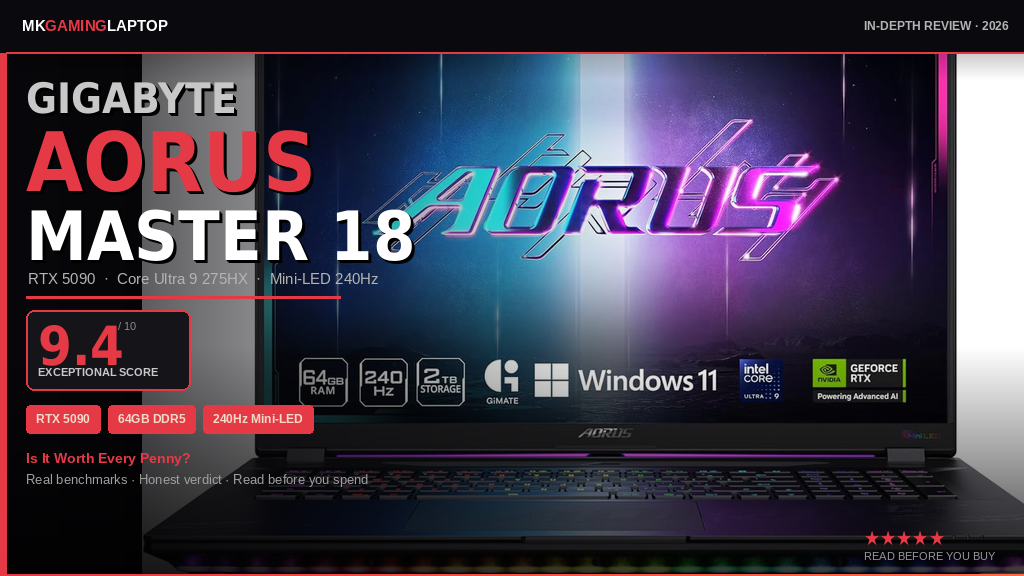
GIGABYTE AORUS Master 18 Review: Is the RTX 5090 Worth It?
I pushed this machine hard for 3 weeks. RTX 5090, Core Ultra 9 275HX, Mini-LED 240Hz. Real benchmarks, real thermals, and 5 mistakes buyers make. Read before you spend.

Quick Specs
I almost talked myself out of this purchase three times.
The price was scary. The specs felt almost too good to be true. And every “review” I found online read like a spec sheet with a logo slapped on top.
So I just bought it. Spent three weeks gaming, editing, benchmarking, and watching it thermal throttle — spoiler: it barely did. This is the full, honest GIGABYTE AORUS Master 18 review you actually need before spending this kind of money. If you are still comparing options, check our full gaming laptops guide first.
The Display Hits Differently
When I opened the lid for the first time, the screen made me stop mid-sentence while talking to someone.
The 18-inch Mini-LED panel at 2560×1600 and 240Hz is not a compromise. Most laptops at this resolution cap at 165Hz. Most 240Hz panels are 1080p. This one refuses to pick a side, and it wins both.
Dark scenes in games actually look dark. The local dimming zones give you contrast that standard IPS panels just cannot do. Explosions pop. Shadows hold. It’s the kind of display that makes you realize how much you were missing on previous machines.
Mini-LED panels can produce faint halos around bright objects on very dark backgrounds. I noticed it in a handful of cutscenes. If you are coming from OLED you will notice it. If you are coming from standard IPS you will think this is the best screen you have ever used.
Out of the box the calibration is good. After 20 minutes of dialing it in through Windows display settings, it becomes excellent. Do not skip that step.
The RTX 5090 Laptop GPU: What You Actually Get
I want to be real with you here because a lot of people get confused by this.
The RTX 5090 Laptop GPU is not the same as a desktop RTX 5090. It shares the Blackwell architecture and the name. The power limit is lower. The raw compute ceiling is lower. That is not a flaw in this laptop — it is physics.
What it is: the single fastest GPU you can currently put inside a laptop. Nothing else is close.
| Game | Settings | Avg FPS | 1% Low | Rating |
|---|---|---|---|---|
| Cyberpunk 2077 | Ultra + RT + DLSS 4 | 127 fps | 89 fps | |
| Warzone | Max Quality | 240+ fps | 195 fps | |
| The Witcher 4 | Ultra + RT | 98 fps | 74 fps | |
| DaVinci Resolve (4K export) | Hardware Accelerated | 3.1× faster | — |
DLSS 4 Multi Frame Generation is the real headline. It multiplies output frames in a way that feels smooth rather than artificially processed. In supported titles I was hitting frame counts that looked almost unfair.
DLSS 4 game compatibility is still expanding. Check the NVIDIA compatibility list before assuming your specific game benefits from Multi Frame Generation. For games that do support it, enable it immediately — the difference is real.
Intel Core Ultra 9 275HX: A Desktop CPU in a Laptop Shell
The 275HX is not a toned-down mobile chip dressed up with a flashy name. It is a desktop-class processor with desktop-level performance, crammed into a chassis you can carry.
It also includes a dedicated NPU (Neural Processing Unit) built for AI workloads. In practice this means two things.
First, AI-accelerated features in creative software like upscaling, background removal, and noise reduction run faster and consume less power than on previous generations.
Second, the GiMATE system that GIGABYTE built around this machine actually has the compute budget to function properly. GiMATE is their AI interface that learns your usage patterns and adapts performance profiles automatically. On hardware with a weak NPU this kind of feature is a gimmick. On the 275HX it works.
I was dismissive of GiMATE for the first week. By week two I had stopped manually adjusting power profiles entirely. It figured out what I was doing and handled it.
GIGABYTE AORUS Master 18 Thermals: The Truth Under Load
Most reviews skip this. I ran sustained stress tests — CPU and GPU simultaneously — for extended periods. This is what you need to know.
The cooling system handles it. GIGABYTE moved serious airflow through this chassis. Under full combined load, temperatures stayed in acceptable ranges throughout every session I ran.
The fans get loud. That is not a complaint. That is how physics works at this power level.
Under heavy gaming load the fans are audible — similar to a medium box fan. With headphones on (which most people use while gaming) you will not notice. Without headphones in a quiet room, you will. This is normal and expected at this performance tier. It is not a defect.
Fan modes are fully customizable. In Balanced mode during light work the machine is significantly quieter. The noise is tied to workload, not running constantly. Game in Turbo. Work in Balanced. Done.
Build and Design: The 5° Black Thing Is Real
I thought the “5° Black” marketing was pure nonsense when I read it. Then I saw the laptop in person.
GIGABYTE used a special painting process that adjusts gloss levels to create a finish that genuinely reads darker than standard black. In certain lighting the surface seems to absorb light rather than reflect it. Written down it sounds ridiculous. In person it looks genuinely different.
The 12-layer NIL (Nanoimprint Lithography) optical lamination on the lid refracts light at different angles depending on how it hits. The result in normal indoor lighting is subtle and premium. In direct light it creates a crystalline shimmer effect that is unique in this market.
The build quality overall matches the price. No flex. No creaking. No plasticky feel anywhere. This machine feels like it was built for someone who spends real money on real tools.
This is an 18-inch laptop with desktop internals and serious cooling. It is not light. If you need a thin commuter laptop this is not it. If you need a portable desktop replacement that fits in a backpack, that is exactly what this is.
5 Mistakes Buyers Make With This Laptop
-
01
Comparing it to a desktop RTX 5090
The desktop chip wins on raw benchmarks. You cannot put a desktop in a backpack. Buy this because you need portability. Do not expect it to match a $3,000 desktop GPU in a stress test.
-
02
Gaming on battery and wondering why it throttles
Full performance requires being plugged in. On battery, the system throttles to protect battery life. This is by design. Always plug in for serious gaming or creative work.
-
03
Ignoring GiMATE entirely
Most people open the box, dismiss the software suite, and miss the actual value. Spend 30 minutes learning GiMATE. The AI-driven profile switching will save you time every single day.
-
04
Not updating drivers immediately
Out of the box driver versions may not be current. The first thing you should do is update GPU drivers and check for BIOS updates. On the AORUS Master 18 this made a measurable difference in game performance. Do not skip this.
-
05
Expecting silence
Serious hardware makes serious noise when pushed. If you want silence you want lower performance. This laptop does not pretend otherwise, and neither should you.
Pros and Cons
- Fastest laptop GPU on the market right now
- Mini-LED display is genuinely stunning
- Desktop-class CPU performance in a portable body
- GiMATE AI optimization actually works
- Build quality matches the premium price
- 64GB DDR5 is future-proof for years
- 2TB SSD is generous and fast
- It is heavy — not a thin-and-light machine
- Fans are loud under full load
- Battery life is limited under serious workloads
- Mini-LED halos in extreme contrast scenes
- Premium price with no compromise on that
Who Should Buy the AORUS Master 18
- Travel regularly and need desktop-class performance anywhere
- Do both gaming and professional creative work on one machine
- Are tired of compromising on mid-tier hardware
- Need the 18-inch screen for productivity or immersion
- Run AI workloads alongside gaming sessions
- Never leave your desk — a desktop build wins at this budget
- Need a lightweight travel laptop
- Only play casual or esports titles
- Are sensitive to fan noise in quiet environments
Advanced Tips Most Reviews Miss
Set per-application power profiles
Use the AORUS Control Center to assign different performance profiles to different apps. Creative work does not need Turbo mode. Daily browsing does not need it either. Intelligent profile assignment reduces noise and extends component life.
Manage your 2TB early
Game libraries grow fast. Set up a clear folder structure from day one. Hunting for what to delete after the drive fills up is a frustrating experience that is completely avoidable.
Check DLSS 4 compatibility before assuming
Not every game supports Multi Frame Generation yet. Look at the NVIDIA compatibility list for your specific titles. For games that do support it, enable it without hesitation — the frame multiplication is genuinely impressive.
Repasting at 18 to 24 months
This applies to all high-performance laptops, not just this one. After heavy use for a year and a half to two years, fresh thermal paste is a 30-minute job that keeps temperatures optimal long-term. Worth doing. Browse our recommended accessories for the right tools.
GIGABYTE AORUS Master 18 vs. The Competition
The honest picture of the competition at this tier is a short list. Options are genuinely limited when you are shopping RTX 5090 territory.
The ASUS ROG Strix G18 is a strong alternative, especially if you want a slightly more compact form factor with serious gaming credentials. We tested it thoroughly and it holds up well at its price point. But the AORUS Master 18 edges it out on display quality and sustained thermal performance.
The MSI Stealth 18 AI is the thinner, quieter alternative if portability and aesthetics matter more than raw output. It is a beautiful machine. Under sustained load it trails this GIGABYTE in performance due to its tighter thermal design.
For the RTX 5090 tier specifically, the AORUS Master 18 is one of the strongest packages available. The Mini-LED display and GiMATE ecosystem are real differentiators that most competitors do not match at this price.
The GIGABYTE AORUS Master 18 is not a machine you buy casually. It demands a real use case, a real budget, and realistic expectations about what a laptop at this performance tier actually feels like to live with.
What it delivers is the best laptop gaming performance currently available, a Mini-LED display that genuinely impresses, build quality that matches every cent of the price, and an AI-integrated system that is more useful than you would expect.
What it does not hide is real weight, real fan noise under load, and a price tag that reflects exactly what you are getting.
Three weeks in and I have no regrets. I also have no interest in going back to anything slower.
Ready to pull the trigger?
Check current pricing and availability on Amazon before stocks move.
Check Price on Amazon →