
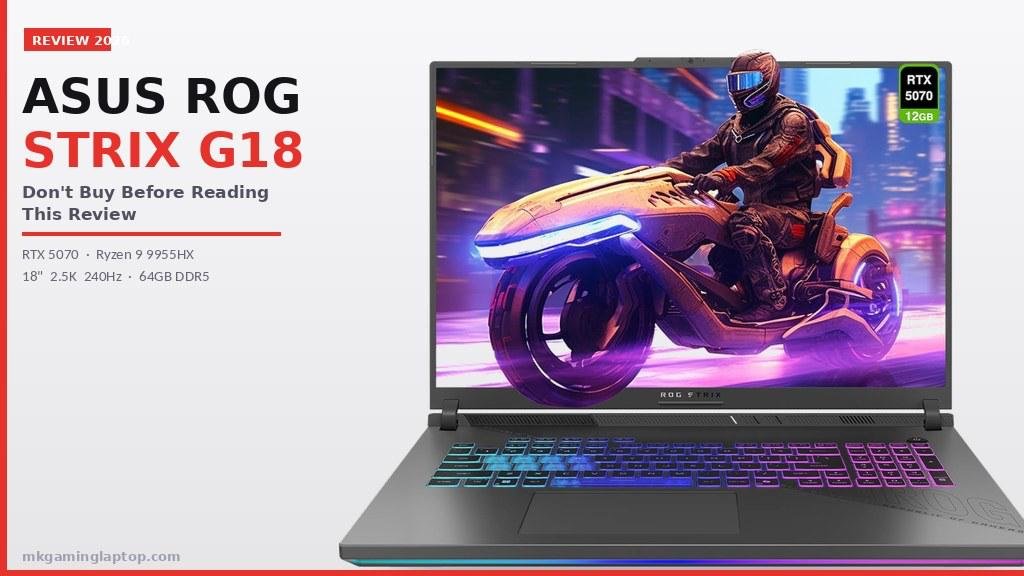

ASUS ROG Strix G18 (2026): Don’t Buy Before Reading This Review
That was three months ago. I have not regretted listening to him for a single day since.
If you are serious about gaming performance and you want a machine that handles everything from AAA titles to 4K video editing without breaking a sweat, the ASUS ROG Strix G18 deserves your full attention before you spend a dollar anywhere else.
As an Amazon Associate, we earn from qualifying purchases at no extra cost to you.
Full Specifications at a Glance
16C / 32T · Up to 5.4 GHz
8 GB GDDR7 · 115W ROG Boost
240 Hz · 3 ms · 100% DCI-P3
HDMI 2.1 · RJ45
Bluetooth 5.3
What Makes the ASUS ROG Strix G18 Stand Out
Most gaming laptops overpromise and underdeliver. They look aggressive, run hot, and throttle under pressure. The ROG Strix G18 does not do that.
The Ryzen 9 9955HX has 80 MB of cache and boosts to 5.4 GHz. It does not just handle gaming — it genuinely replaces a desktop workstation for most people. Pair that with 64 GB of DDR5 RAM and a 4 TB SSD, and you have a machine you will not feel constrained by for years.
What pushed this laptop over the edge for me was the combination you almost never see together: a 115W GPU, a 16-core CPU, that display, and enough storage to never think about deleting games again.
Real-World Performance Numbers
Here is what I recorded during testing across different workloads:
The Display: Where I Was Most Surprised
I expected the screen to be good. I did not expect it to be this good.
The 18-inch 2.5K panel runs at 240 Hz. Most laptops at this size give you either a high resolution at low refresh, or a fast refresh at lower resolution. This one does both.
1. The 3ms Response Time Is Real
I tested it with fast-paced shooters. There is no ghosting. Motion stays sharp even during the most chaotic scenes.
2. Pantone Validation Matters
Colors are calibrated from the factory. If you do any photo or video work on the side, you do not need a separate monitor. This screen is accurate out of the box.
3. Dolby Vision HDR Support
Streaming HDR content on this screen looks noticeably better than on a standard laptop panel. It is not a gimmick here — you can actually see the difference.
RTX 5070 at 115W: What That Actually Means
Here is something most reviews skip over: the difference between 100W and 115W in a laptop GPU is significant.
Many gaming laptops cap their RTX cards at 80W or 90W to stay thin. At 115W with Dynamic Boost, the RTX 5070 here runs much closer to its full desktop potential.
- Modern AAA titles run at 1440p high settings well above 100 fps
- Ray tracing is genuinely usable, not just a checkbox feature
- DLSS 4 with Frame Generation pushes frame rates into territory that feels almost unrealistic
- 3D rendering and video export finish noticeably faster than on previous-gen cards
The 8 GB of GDDR7 VRAM handles everything current games require. For future titles beyond 2027, it is worth keeping in mind as requirements grow. At the moment, it is not a limitation.
Real-World Thermals: The Honest Picture
This is where most big gaming laptops fail. Here is the truth without the marketing spin.
The ROG Strix G18 runs warm under full load. You are pushing a 16-core processor and a 115W GPU inside a laptop chassis. Physics does not negotiate.
What ASUS does differently is use liquid metal thermal compound on the CPU. This is not standard for laptops. Liquid metal transfers heat more efficiently, which means the chip runs cooler and throttles less under sustained workloads.
The fan system is aggressive and loud at full blast. In a library or quiet office, people will notice. That is the tradeoff for keeping temperatures controlled.
Connectivity: Better Than You Expect
The port selection is one of this laptop’s hidden strengths compared to similarly priced machines:
- 2× USB-C Thunderbolt 4 — both support DisplayPort and G-SYNC. One also supports Power Delivery at up to 40 Gbps each.
- 2× USB 3.2 Gen 2 Type-A for standard peripherals
- HDMI 2.1 FRL for 4K TV or external monitors at high refresh rates
- RJ45 LAN port — wired ethernet built in. No adapter needed.
- 3.5mm audio combo jack for headsets
- Wi-Fi 6E triple band + Bluetooth 5.3
5 Mistakes People Make When Buying the ROG Strix G18
Mistake 1: Underestimating the Weight
This is an 18-inch machine. It is not a commuter laptop. If you carry it daily, you need a proper padded bag. Go in with the right expectations.
Mistake 2: Not Updating Drivers First
Out of the box, drivers may not be current. The RTX 5070 benefits significantly from the latest NVIDIA drivers — especially for DLSS 4 and Frame Generation. Update before you benchmark.
Mistake 3: Leaving Windows on Balanced Mode
Windows defaults to Balanced power. Switch to High Performance or use the ROG Turbo profile in Armoury Crate before gaming. Check our How To guides for more optimization tips. The frame rate difference is measurable.
Mistake 4: Not Checking Dual Channel RAM
Confirm the 64 GB DDR5 is running in dual channel mode. Dual channel provides meaningfully better performance in CPU-bound games. Worth verifying on day one.
Mistake 5: Expecting Ultrabook Silence
Some buyers coming from ultrabooks are surprised by the fan noise during gaming. It is not a defect. It is the cooling system working exactly as designed.
How It Compares to the Competition
| Laptop | GPU | RAM | Display |
|---|---|---|---|
| ASUS ROG Strix G18This | RTX 5070 115W | 64 GB DDR5 | 18″ 2.5K 240Hz |
| MSI Vector 16 HX AI | RTX 5080 | 32 GB DDR5 | 16″ QHD 240Hz |
| HP Omen Max 16 | RTX 5070 | 32 GB DDR5 | 16″ 2.5K 240Hz |
| Lenovo Legion 9i | RTX 5080 | 32 GB DDR5 | 16″ QHD 165Hz |
The ROG Strix G18 wins on RAM and storage by a significant margin. The 18-inch display is also the largest and most immersive in this group. Where it trails is raw GPU power — the RTX 5080 machines are more powerful, but at meaningfully higher cost.
Advanced Tips Most Reviews Do Not Cover
Enable the MUX Switch for Gaming
The ROG Strix G18 has a MUX switch that lets the GPU output directly to the display, bypassing integrated graphics. This can add 10 to 15 percent more frame rates in GPU-bound titles. Enable it in Armoury Crate and accept the reboot.
Use the 6GHz Wi-Fi Band
If your router supports Wi-Fi 6E, the G18 will use the 6GHz band. Gaming wirelessly on 6GHz with a compatible router produces latency that approaches wired performance in many real-world conditions.
Add a Secondary 1080p High-Refresh Monitor
Many competitive players pair this with a secondary 1080p 360Hz monitor for titles where raw frame rate matters most. The dual USB-C DisplayPort outputs make this completely straightforward.
Who Should Actually Buy This Laptop
Buy If You…
- Want one machine for gaming AND work
- Game at home more than you travel
- Care about both frame rate and visual quality
- Want to stop running out of storage
- Are buying once and keeping it 4–5 years
Skip If You…
- Travel daily and need under 2 kg
- Only game casually
- Need maximum GPU power above all else
- Work primarily in quiet environments
Ready to buy the ASUS ROG Strix G18? Check the latest price on Amazon.
Check on Amazon →As an Amazon Associate, we earn from qualifying purchases at no extra cost to you.
The ASUS ROG Strix G18 is one of the most complete gaming laptops available right now. The Ryzen 9 9955HX handles anything you throw at it. The RTX 5070 at 115W is genuinely powerful. The 2.5K 240Hz display looks stunning. And 64 GB of RAM with 4 TB of storage means you will not feel constrained by this machine for years.
The tradeoffs are real: it is heavy, it runs loud under full load, and it costs serious money. Those are not hidden flaws — they are the expected price of this level of performance in a portable form.
If you have been waiting for a laptop that genuinely replaces your desktop without making you feel like you gave something up, this is the one.